You don’t need more confidence; you need more evidence.
There’s lots of advice aimed at women about confidence: speak up more, believe in yourself, back yourself, stop doubting yourself. None of that is necessarily bad advice, but it often makes confidence sound like something you’re supposed to acquire before you do the thing.
It’s assumed that one magical day you’ll wake up feeling confident enough to apply for the role, raise your prices, publish the post, have the awkward conversation, or make the decision without checking it with three other people first.
But confidence rarely works like that. Most of the time…
Confidence comes after you start
I think of this as a confidence–competence loop. You start with enough courage to try something, repetition builds competence, competence makes the experience more familiar, and over time you gather evidence that you can actually do it.
The order matters.
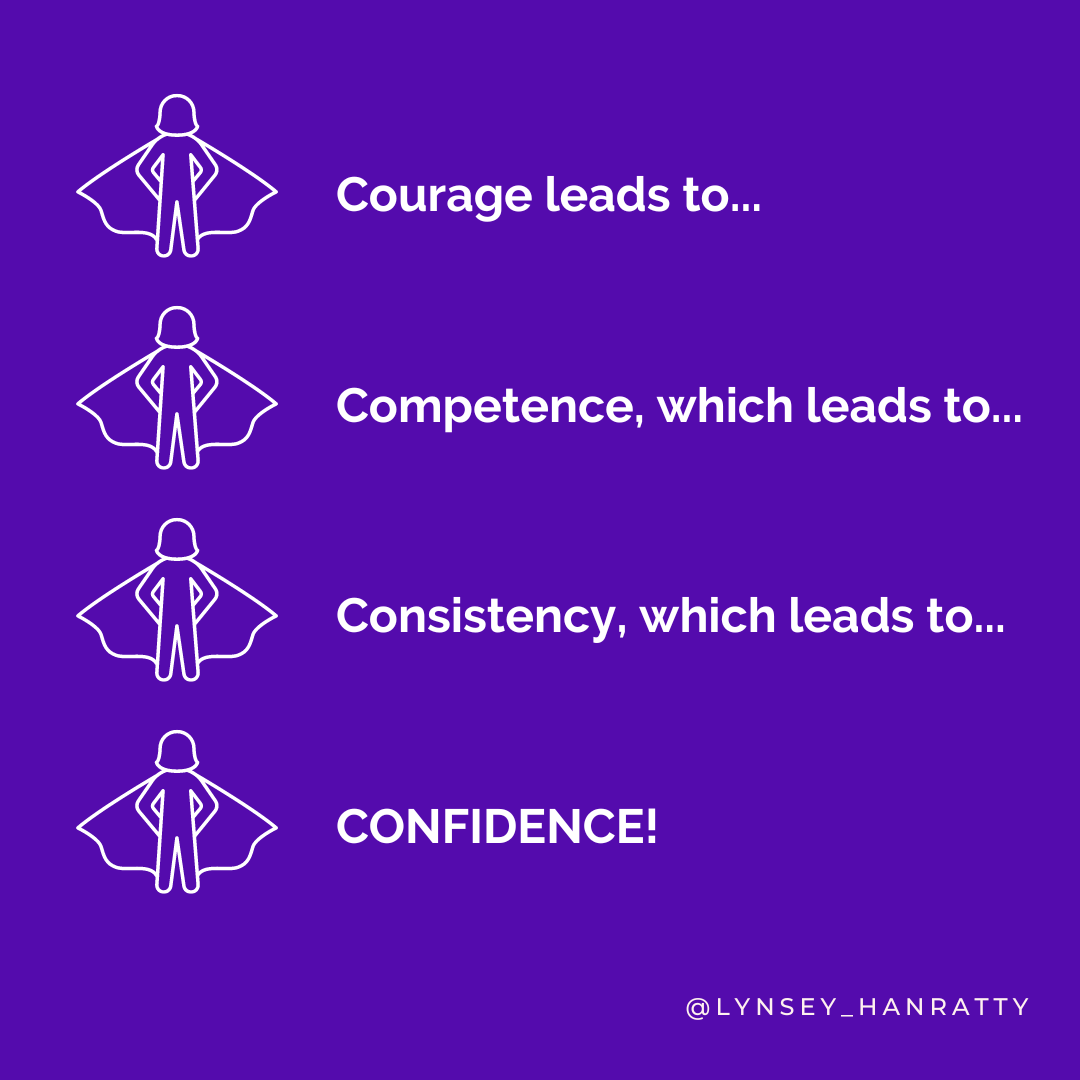
The 4 Cs of the Confidence–Competence Loop
Courage — doing the thing before you feel completely ready.
Competence — getting better through practice, experience and figuring out what works.
Consistency — doing it often enough that you gather real evidence that you can handle it.
Confidence — trusting yourself more because you now have experience to draw on.
So it’s courage → competence → consistency → confidence, not the other way around.
Think about something you’re now comfortable doing that felt awkward at the beginning: driving, presenting, leading a meeting, having a difficult conversation or walking into a room where you knew nobody.
You didn’t become confident sitting at home thinking confidently about it. You did it enough times that your brain eventually stopped thinking you were in mortal danger.
That’s why waiting until you feel confident can keep you stuck for a very long time. What you often need first is enough courage to give it a try.
And then there are the notions
If you grew up in Ireland, there can be another layer to this because we have a very complicated relationship with confidence.
There’s being confident, and then there’s having notions about yourself.
Thinking you’re somebody, or getting above your station or taking yourself a bit too seriously.
For women in particular, that can create a strange double bind. We’re encouraged to be ambitious and put ourselves forward, while also being careful not to appear arrogant, difficult, or pushy.
So waiting until you feel completely certain can become a kind of protection - ‘If I’m sure I’m good enough, perhaps nobody can accuse me of having notions.’
The problem is that level of certainty never seems to show up, and while you’re waiting, someone with less evidence than you may already have put their hand up.
Confidence needs evidence
This is where the usual conversation about confidence misses something - every time you act, you gather evidence.
You have the difficult conversation and discover you can handle it. You publish something and survive other people having opinions about it. You make a decision without knowing exactly how it will turn out. You say no and find that another adult’s disappointment is slightly uncomfortable but not catastrophic.
The evidence isn’t that everything always goes well. It’s that you can deal with what happens next, and that’s more useful than trying to manufacture confidence on demand.
Sometimes overthinking is an attempt to remove risk
Overthinking doesn’t always look like panic, particularly in capable women. It can look extremely sensible: more research, another spreadsheet, one more conversation, rereading the email, reopening yesterday’s decision or asking someone else what they think.
Sometimes you genuinely do need more information to make that decision. But there comes a point where additional thinking isn’t useful; you’re just trying to reach a level of certainty where you know exactly how everything will turn out.
Leadership, business and life aren’t that compliant, so at some stage you have to make the call with the information you have.
Do you need information, or permission?
This is a question I come back to a lot in coaching because the two can feel remarkably similar.
Maybe you genuinely need to understand the financial implications or have another conversation before you decide.
But sometimes you already know what you want to do and you’re looking for somebody else to tell you that your choice is reasonable.
That’s less about confidence and more about self-trust. Can you make that decision without everyone being delighted with it? Can you take decisive action without knowing that you’ll never regret it?
Those are harder questions, but they’re also where the useful evidence is found.
Make the decision smaller
It also helps to stop treating every decision you make as though it’s being carved into stone.
Could you test something for a month? Have one conversation? Set the boundary once? Apply for the role before deciding whether you’d actually take it?
Instead of asking How do I become confident enough to do this?, try asking:
What’s the smallest useful action I could take that would give me more evidence?
You can spend six months thinking about how something might feel, or you can try a version of it and find out.
You probably have more evidence than you think
We’re very good at normalising the things we’ve already handled: the difficult year, the job we learned on the fly, the conversation we’ve had despite the dread, the mistake we recovered from, or the time we thought I have absolutely no idea what I’m doing here and somehow worked it out.
That evidence counts.
Confidence isn’t believing everything will go well. It’s knowing that if things don’t go exactly to plan, you have some evidence that you can think, adapt, ask for help, change direction and deal with what happens next.
So if you’re waiting to feel more confident before you make your next move, perhaps the better questions are:
What evidence do I already have?
What do I genuinely still need to know?
Am I looking for information or permission?
And what would I do here if I allowed myself to have a few notions?
You don’t need to become fearless or convince yourself that everything will work perfectly. You need enough courage to start, and then you give confidence something to build on.
If you're carrying this kind of weight - doing everything right and still feeling like you're fighting for space - I'd love to have a conversation.
Book your free 20-minute Clarity Call below.